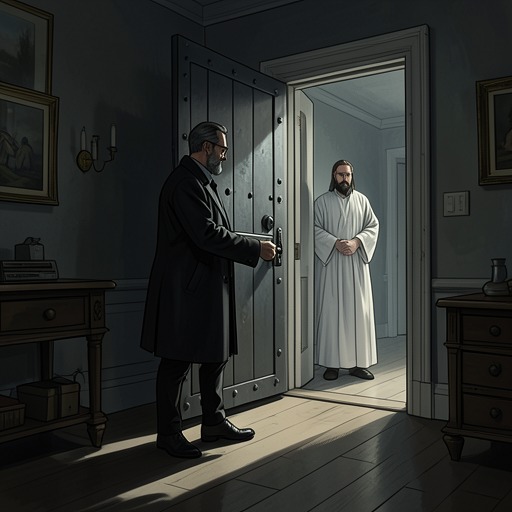
The Trial of Milady
The Three MusketeersThe Trial of Milady is the decisive private tribunal against Charlotte Backson, formerly the Comtesse de la Fere and later Milady de Winter, Baroness of Sheffield. Convened outside ordinary judicial authority, it gathers the victims, pursuers, and witnesses of her crimes into a single room and transforms scattered accusations into a public reckoning. Its significance lies in the collision between gentlemanly honor, political power, formal law, and extrajudicial justice: Athos insists that Milady must be tried rather than assassinated, yet the assembled judges already possess the power and intention to condemn her.
Causes and Setting
The tribunal arises after Milady’s campaign of manipulation and violence has produced consequences that official institutions have not adequately resolved. d'Artagnan identifies her as the poisoner responsible for the death of Constance Bonacieux. Lord de Winter connects her to the assassination of the Duke of Buckingham, explaining that she corrupted Felton, placed the poniard in his hand, and made him kill the duke. Athos brings the deepest personal accusation: he once married her, sacrificed family approval, wealth, and name to the marriage, and later discovered that she bore a fleur-de-lis brand, a mark associated with a criminal sentence.
The scene therefore combines several kinds of evidence and injury. Political assassination, poisoning, religious and judicial punishment, marriage, betrayal, and attempted escape converge in Milady’s person. The trial is not merely a hearing about one recent offense; it is an effort to assemble a coherent identity from the succession of names under which she has acted. Athos names her as Charlotte Backson, Comtesse de la Fere, and Milady de Winter, forcing the aliases to stand together before the witnesses who know different parts of her history.
Procedure and Accusations
The proceedings begin when d'Artagnan arrives armed and apparently ready to kill Milady. Athos immediately orders him to put away his weapon, declaring that the woman must be tried, not assassinated. That command establishes the tribunal’s governing distinction. The men claim to replace impulsive murder with judgment, and Athos invites Milady to defend herself before the accusations are presented.
Athos then formally assigns the roles of the proceeding: d'Artagnan is to accuse first, followed by Lord de Winter and then Athos himself. The language of the scene gives each charge the solemnity of a legal indictment, even though no ordinary court has authorized the hearing. d'Artagnan accuses Milady before God and men of poisoning Constance Bonacieux, who died the previous evening. Lord de Winter accuses her of causing the Duke of Buckingham’s assassination and supplies a chain of responsibility: after receiving d'Artagnan’s warning letter, he had Milady arrested and entrusted her to a loyal servant, but she corrupted that servant and turned him into the duke’s murderer.
Athos’s accusation is both evidentiary and autobiographical. He explains that he married Milady when she was young, against the wishes of his family, and gave her his wealth and name. His discovery of the fleur-de-lis on her left shoulder revealed a hidden criminal past and shattered the identity she had presented to him. Milady challenges the legality of that history by demanding to know which tribunal pronounced the sentence and who carried it out. Her objection exposes the tribunal’s central weakness: the accusers rely on a prior punishment whose procedure they cannot fully reproduce, while claiming the authority to impose a new one.
The Executioner’s Testimony
The man in the red cloak supplies the missing witness and turns the trial into a revelation of buried history. When Milady disputes the legitimacy of the brand, he identifies himself as the executioner of Lille and declares that he knows her. His testimony traces the crime for which she was branded to her earlier life as a nun in the convent of the Benedictines of Templemar.
According to the executioner’s account, Milady seduced a young priest with a simple and trusting heart. The priest was condemned, and the executioner himself was drawn into the punishment because he was believed to be the priest’s brother. After the identity of his brother was proved, he was released; he nevertheless preserves the event as the reason Milady was branded. His testimony thus links religious transgression, institutional punishment, mistaken identity, and the visible mark on Milady’s body. The fleur-de-lis is not treated as an abstract emblem but as a material sign that carries a history of accusation and suffering across the identities she has adopted.
The testimony also changes the balance of the room. Until the executioner speaks, Milady can challenge the tribunal by questioning the source of the brand. Once he appears as the person who carried out the sentence, the hidden past becomes embodied before her. Her terror and plea for mercy replace her earlier defiance, while the witnesses’ separate accusations are joined to a single history of repeated deception and violence.
Sentence and Moral Authority
Athos asks d'Artagnan what penalty he demands, and d'Artagnan answers that the punishment should be death. The question makes the proceeding resemble a formal court, but the answer also reveals its retaliatory structure: the tribunal is driven by the losses suffered by the accusers and their allies. The death of Constance Bonacieux, the assassination of the Duke of Buckingham, Athos’s ruined marriage, and the broader threat posed by Milady are gathered into one demand.
Athos finally pronounces the sentence. Addressing her by all three names, he declares that her crimes have wearied men on earth and God in heaven, tells her to pray if she knows a prayer, and announces that she is condemned to die. The declaration functions simultaneously as identification, judgment, curse, and command. It gives Milady no practical avenue of escape, although the tribunal had earlier offered her the formal liberty to justify herself.
Milady attempts to resist through pride, but her strength fails. The narrative presents her departure as irrevocable: she does not offer meaningful resistance and is taken from the cottage, followed by Lord de Winter, d'Artagnan, Athos, Porthos, and Aramis. The abandoned room, with its broken window, open door, and smoky lamp, marks the end of the hearing and the transition from judgment to execution.
Law, Power, and Narrative Significance
The trial’s improvised justice stands in deliberate tension with the institutions surrounding the principal characters. Earlier, Monsieur Bonacieux was taken to the Bastille, insulted, harshly treated, and brought before a commissary under a procedure designed to intimidate rather than protect him. Athos, when mistakenly arrested in d'Artagnan’s place, protected his friend by declaring that he was Athos and supplying distinguished witnesses, including M. de la Tremouille; his name and connections forced the examining officials to hesitate. These episodes establish a world in which official procedure is already shaped by rank, military prestige, and political pressure.
The king and the cardinal publicly insist that cases should go before judges, even while their rivalry places armed retainers and political interests around every conflict. Louis XIII maintains that an edict remains an edict and that fighting is forbidden, yet he secretly arranges to receive the four men who have fought the cardinal’s Guardsmen. The cardinal’s power likewise operates through surveillance, imprisonment, and political persecution. Against this background, Athos’s tribunal is neither a simple rejection of law nor a faithful substitute for it. It borrows the vocabulary of legal judgment while relying on personal honor, collective memory, and the authority of witnesses who have suffered under Milady’s actions.
Athos’s earlier counsel to d'Artagnan had already formulated the tribunal’s logic as a choice between peace and war. He proposed a solemn neutrality agreement, backed by an oath never to expose or attack one another; if Milady refused, he would appeal to the chancellor, the king, and the hangman, move the courts against her, denounce her as branded, and kill her if she were acquitted. The completed trial fulfills that threat in concentrated form. It seeks official remedies, but it also reserves private violence when official acquittal would fail to satisfy the demands of honor.
When the cardinal later confronts d'Artagnan, he identifies the danger with exact severity: those who punish without authorization are assassins. His statement exposes the tribunal’s unresolved contradiction. Athos and his companions distinguish judgment from assassination by staging a hearing and allowing accusation and defense, but they remain unauthorized judges whose sentence depends on their own power to enforce it. The scene therefore produces catharsis without delivering uncontested justice. Milady’s crimes are made legible, her aliases are collapsed into one identity, and her victims receive a form of recognition; yet the method of judgment remains morally and politically unstable, revealing how readily a society governed by royal, ecclesiastical, military, and aristocratic powers turns justice into a contest over who may name, condemn, and punish.